
What Is Social Media AI? (Quick Answer)
Social media AI is software that uses artificial intelligence to help you create content, schedule posts, analyze performance, and understand your audience faster and with less manual effort.
Whether you’re generating captions with a single click, finding the best time to post, or tracking brand sentiment across millions of conversations, social media AI handles the parts of the job that used to eat hours of your week.
In 2026, this isn’t experimental technology. According to recent industry surveys, 96% of social media managers now use AI tools daily. The question isn’t whether to use AI in your workflow; it’s which tools are actually worth your time.
This guide covers the eight best social media AI tools available right now, what each one does well, who it suits best, and how to pick between them. If you’re thinking about how AI fits into your broader content strategy, our guide on AI in content marketing covers the wider picture.
What to Look for in a Social Media AI Tool
Not every tool marketed as “AI-powered” delivers the same depth. Here’s what separates genuinely useful social media AI from tools that just stick a chatbot on top of a basic scheduler.
- Real AI capabilities, not just automation. Look for tools that use natural language processing for sentiment analysis, generative AI for content drafting, and machine learning that can predict performance before you hit publish. Basic scheduling automation doesn’t qualify.
- Platform coverage. The top platforms in 2026 include Instagram, Facebook, LinkedIn, TikTok, X (Twitter), YouTube, Threads, and Bluesky. Tools that cover most of these save you from juggling multiple subscriptions.
- Content creation and publishing in one place. One of the most common workflow headaches is generating AI content in one tool, then copying it into a separate scheduler. The best social media AI tools handle both steps without making you context-switch.
- Analytics that surface insight, not just numbers. Good AI analytics don’t just show engagement figures. They explain what drove them, which content is trending with which segments, and what to change next time.
- Ease of use. If a tool’s AI features are buried behind menus or need heavy prompt engineering every session, it slows you down more than it helps.
The Best Social Media AI Tools in 2026
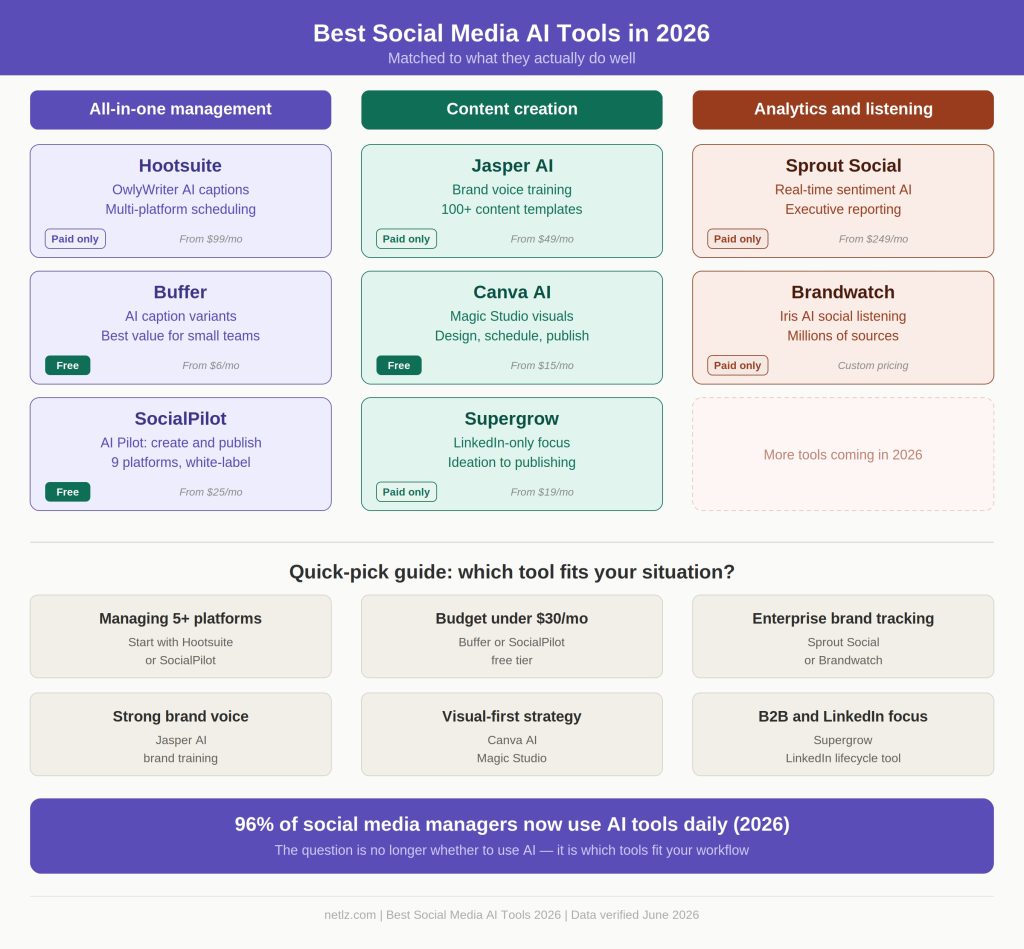
Here’s a quick comparison before we get into the detail:
| Tool | Best For | Free Plan | Starting Price |
| Hootsuite | Multi-platform teams at scale | No | ~$99/mo |
| Sprout Social | Sentiment analysis and enterprise | No | ~$249/mo |
| Buffer | Small teams and solo creators | Yes | $6/mo |
| Jasper AI | Brand voice content generation | No | $49/mo |
| Canva AI | Visual content and design | Yes | $15/mo |
| Brandwatch | Social listening and analytics | No | Custom pricing |
| SocialPilot | Scheduling plus AI combined | Yes | $25/mo |
| Supergrow | LinkedIn-focused growth | No | $19/mo |
Best for All-in-One Management: Hootsuite
Hootsuite has been around long enough to feel like furniture in most marketing stacks, but its AI capabilities in 2026 are genuinely substantive. The platform’s OwlyWriter AI generates platform-optimized captions, repurposes top-performing posts into new content formats, and powers an AI content calendar that recommends posting schedules based on real audience engagement patterns rather than generic benchmarks.
What sets Hootsuite apart from lighter tools is the integration of social listening directly into the content creation workflow. When OwlyWriter drafts a caption, it can factor in trending topics relevant to your industry in real time, which keeps posts from feeling generic or out of step with the conversation.
Best for: Marketing teams managing five or more social accounts across multiple platforms who need AI content generation, scheduling, and analytics in a single dashboard. Limitation: It’s the most expensive starting point on this list, and smaller teams often pay for capabilities they never use.
Best for Sentiment Analysis: Sprout Social
If understanding your audience is the priority, Sprout Social’s AI Assist is the most sophisticated option most marketing teams will find in 2026. Its real-time sentiment analysis tracks mentions and direct messages across platforms, automatically categorizes tone, and flags emerging issues before they escalate.
For customer-facing brands or any business where reputation matters, the automated response suggestions are particularly useful. AI Assist drafts contextually relevant replies based on the sentiment and content of inbound messages. A human agent reviews before sending, which keeps the quality bar high without the time cost.
The reporting automation is another standout. Sprout can turn raw engagement data into formatted executive summaries without manual analysis, which makes a real difference for teams that report to leadership on a regular cadence.
Best for: Mid-market and enterprise brands with active customer engagement and a need for deep sentiment intelligence. Limitation: The pricing puts it out of reach for solopreneurs and very small teams.
Best for Small Teams: Buffer
Buffer’s value for the price is the strongest on this list for teams working with a tight budget. The free tier covers core scheduling across multiple platforms. Paid plans, starting at $6/month per channel, add AI-assisted caption drafting, hashtag suggestions, and performance analytics.
Where Buffer really earns its keep is in taking a single content idea and generating multiple platform-specific versions from it. Write one concept, and Buffer’s AI will adapt the format, length, and tone for Instagram, LinkedIn, and X without you having to touch it again. That matters for small teams without a specialist for each platform.
Best for: Freelancers, small businesses, and early-stage startups that want AI-assisted posting without a large software budget. Limitation: The analytics and social listening capabilities are much lighter than Sprout or Hootsuite. High-growth teams tend to outgrow it.
Best for Content Generation: Jasper AI
Jasper isn’t a social media management platform. It’s a dedicated AI writing tool that social media teams use specifically for content creation. Its brand voice training feature is what sets it apart: you feed it examples of your existing content, and it learns your tone, style, and vocabulary, then applies that across everything it generates afterward.
With over 100 templates covering social captions, ad copy, thread ideas, and hashtag research, Jasper handles the content creation problem well. The output still needs human review before publishing, but the drafts are consistently stronger than what you get from general-purpose AI without heavy prompting.
Best for: Brands with a distinct voice that want AI output to actually sound like them rather than a generic chatbot. Limitation: You still need a separate tool to publish. Jasper creates content; it doesn’t distribute it.
Best for Visual Content: Canva AI
Visual content drives engagement on every major platform, and Canva’s AI tools in 2026 make it the most accessible option for producing social media visuals at scale. The platform brings together templates, AI image generation, an AI video editor, and scheduling in one workspace, so creative teams can ideate, design, and publish without switching between apps.
Canva’s Magic Studio suite covers image generation from text prompts, automatic resizing for different platforms, AI-assisted captions, background removal, and basic animation. For teams without a dedicated graphic designer, it handles most visual production requirements.
Best for: Social media managers who need to produce quality visual content consistently without a full design team. Limitation: AI-generated images occasionally need manual polish to match a specific brand aesthetic. The volume is impressive; the consistency takes some oversight.
Best for Social Listening: Brandwatch
Brandwatch is solving a different problem than most tools on this list. It doesn’t help you create or schedule content. It helps you understand what the world is saying about your brand, your competitors, and your industry. Its Iris AI engine pulls conversations from social networks, forums, blogs, and news sources to surface trends, sentiment shifts, and emerging topics that should feed into your strategy.
For enterprise teams, competitive intelligence programs, and PR-sensitive brands, the depth of analysis here is genuinely hard to match. It can monitor millions of sources across multiple languages and identify patterns that no human analyst could realistically process.
Best for: Larger organizations that need to understand audience perception and competitive positioning before building their content approach. Also useful for crisis monitoring. Limitation: Brandwatch is primarily an intelligence and analytics tool, not a publishing platform. Teams typically pair it with a separate scheduler.
Best for Scheduling and AI Together: SocialPilot
SocialPilot’s AI Pilot closes the workflow gap that frustrates most teams: it combines AI content generation with multi-platform scheduling in a single system. You generate captions, hashtags, and post ideas, then publish them without ever switching applications or manually copying text between tools.
It covers all the major platforms including Facebook, Instagram, LinkedIn, X, TikTok, YouTube, Google Business Profile, Bluesky, and Threads. For agencies or teams managing multiple client accounts, the white-label options and bulk scheduling features cut operational overhead significantly. There’s a free entry-level plan, and paid tiers start at a price most small-to-medium businesses can absorb without a lengthy approval process.
Best for: Agencies, freelancers, and marketing teams that want AI content generation and publishing in one tool at a reasonable price.
Best for LinkedIn: Supergrow
LinkedIn content operates on its own terms: longer formats, a professional register, and algorithm patterns that differ from every other platform. Supergrow is built specifically for this. Rather than being a general-purpose social media AI tool, it covers the full LinkedIn content lifecycle from ideation and drafting through scheduling and performance analysis, all within one workspace.
For B2B brands and executives who treat LinkedIn as a primary growth channel, Supergrow removes the friction of building a consistent posting cadence. It’s narrower in scope than the tools above, but it goes considerably deeper on the one platform where that depth matters most.
If you’re working on a broader B2B social media strategy, pairing Supergrow with a general-purpose scheduler gives you depth on LinkedIn alongside coverage across other channels.
Best for: B2B marketers, founders, and sales teams that want predictable results from LinkedIn without building a content system from scratch.
How to Choose the Right Social Media AI for Your Business
With eight tools on this list, the decision usually comes down to four questions.
- How many platforms are you managing? If you’re active on five or more networks, prioritize broad integration coverage. Hootsuite, SocialPilot, or Buffer are the right starting points. If you’re focused on one or two platforms, a specialized tool typically outperforms the generalists.
- Where is your biggest bottleneck? Content creation, scheduling, analytics, and social listening are four distinct problems. The best social media AI tools solve one job well. Match the tool to the actual problem, not to the most impressive marketing copy.
- What’s your team size and budget? Sprout Social and Hootsuite deliver enterprise-grade AI but are priced to match. Buffer and SocialPilot offer comparable core functionality for smaller operations at a fraction of the cost.
- Do you need content creation and publishing in one place? If switching between tools is a daily friction point, SocialPilot or Hootsuite are the right choices. Both handle creation and distribution in a single workflow.
For businesses that want expert help with both tool selection and ongoing strategy, NetLZ’s social media management services cover both sides.
FAQs About Social Media AI
What is social media AI?
Social media AI refers to artificial intelligence software that automates or enhances social media tasks including content creation, scheduling, sentiment analysis, hashtag research, and performance analytics. It relies on technologies like natural language processing, generative AI, and machine learning to reduce manual effort and improve outcomes.
What is the best AI tool for social media management in 2026?
It depends on what you need. Hootsuite leads for multi-platform teams at scale. Sprout Social is strongest for sentiment analysis and customer intelligence. Buffer offers the best value for small businesses and solo creators. SocialPilot is the top pick if you want AI content generation and publishing combined in one workflow.
Can AI fully automate social media?
AI handles scheduling, caption drafting, hashtag research, and basic reporting well. It works best alongside human strategy rather than replacing it entirely. Brand voice, creative judgment, and community engagement still benefit from human input.
Are there free social media AI tools?
Yes. Buffer, Canva, and ChatGPT all offer free tiers covering core social media AI features. SocialPilot has a free entry-level plan as well. Paid plans unlock scheduling across more accounts, advanced analytics, and team collaboration features.
How does AI help with social media marketing?
AI generates content ideas, drafts captions, finds optimal posting times, analyzes audience sentiment, monitors competitors, and automates repetitive publishing tasks. Most marketing teams report saving several hours per week. The gains compound over time when AI handles volume and human effort can stay focused on strategy and genuine audience relationships.
Updated for 2026. Tool pricing and features verified as of June 2026.
netlz.com