

A first-time patient walking into a med spa or a chiropractic office is not making a casual decision. They are trusting someone with their body, their face, or their pain, often before ever speaking to them in person. That kind of decision gets made almost entirely on trust signals: reviews, before-and-after results, credentials, and how a practice presents itself online. What surprises us every time we look at the data is how little competition exists for the keywords that build that trust. Medical spa marketing and chiropractic marketing are two of the least competitive, highest-value niches we have looked at recently, and most practices in both categories are not taking advantage of it.
Our team at NetLZ has worked across several healthcare verticals, and these two stand out right now as genuine opportunities rather than crowded fields where every competitor is already doing everything right.
Why Medical Spa Marketing Is Still Wide Open
Medical spa marketing sits in an unusual spot. The services themselves, things like injectables, laser treatments, and skin resurfacing, carry high price points and high-intent searches, yet the organic search results for many of these terms are dominated by directories and thin local listings rather than strong, purpose-built content from actual practices.
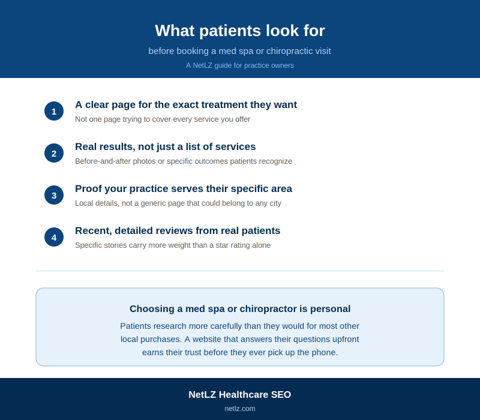
This creates real room for a med spa marketing agency approach that goes beyond a homepage and a services list. Practices that build out dedicated pages for each treatment, back them with real before-and-after content, and structure their site around the actual questions patients are searching tend to separate themselves from competitors fast, simply because so few practices in this space are doing it well yet.
The trust factor cuts both ways here too. A patient researching a cosmetic procedure is often more anxious and more thorough than a typical local search customer, reading reviews, comparing providers, and looking for any signal that a practice is credible. A website that answers those unspoken questions directly, without the patient needing to dig for reassurance, tends to convert noticeably better than one that only lists services and prices.
What Chiropractic Marketing Gets Right and Wrong
Chiropractic marketing has a similar dynamic. A lot of chiropractic websites we come across do the basics reasonably well, a homepage, a list of conditions treated, an appointment request form, but very few go further into the specific pain points and questions that drive someone to search for a chiropractor in the first place.
Marketing for chiropractors works best when it moves past generic phrases like “back pain relief” and into the specific situations patients are searching for: pain after a car accident, pain from sitting at a desk all day, pain during pregnancy, pain after a specific type of injury. Each of these is a distinct search with distinct intent, and a chiropractic practice that builds content around each one captures search traffic that a single generic services page never will.
The practices seeing the strongest results are the ones treating their website less like a digital business card and more like a resource that answers the questions a worried, uncomfortable person is typing into Google at eleven at night.
The SEO Side: Med Spa SEO and Chiropractic SEO
Med spa SEO and chiropractic SEO both benefit from the same core approach, even though the audiences look different on the surface. Both need dedicated, detailed pages for each service or condition rather than one page trying to cover everything. Both benefit enormously from location-specific content, since almost all of these searches happen with local intent. And both are still competitive enough to reward real, useful content, without the years of entrenched competition you would find in a category like personal injury law or general dentistry.
A practice looking for a chiropractor SEO expert or working through SEO for medical spas on their own should start with the same question in both cases: does every page on the site answer a real question a real patient is asking, in enough detail that it could stand on its own as a helpful resource. Most practices in these categories are still answering no to that question, which is exactly why the opportunity exists.
Reviews and Trust Signals Matter More in These Niches
Because these are high-trust decisions, reviews carry more weight here than they do in most other local service categories. A single detailed, specific review describing a real result, whether that is pain relief after a car accident or confidence after a cosmetic treatment, does more to move a prospective patient than almost any other piece of content on a website.
This is part of why review volume and review content belong in the same conversation as local SEO services rather than treated separately. A steady flow of detailed, specific reviews changes how a practice shows up both in search results and in a patient’s own decision-making process, especially in categories where the decision itself feels personal and a little vulnerable. Encouraging patients to leave real, detailed feedback after a visit is one of the simplest things a med spa or chiropractic practice can build into its regular routine.
How This Compares to Other Healthcare Verticals We Work In
Med spa and chiropractic marketing share a lot of DNA with other healthcare verticals we work in regularly. We approach plastic surgery marketing with the same emphasis on trust signals and detailed, procedure-specific content, since the decision-making process for a patient is remarkably similar across both categories.
Dental marketing follows a related pattern too, built around the same idea that patients are searching for specific answers to specific worries, not just a generic list of services.
What we have found across all of these healthcare niches is that the practices willing to invest in real, detailed, patient-focused content consistently outperform the ones treating their website as a formality. Med spas and chiropractic practices happen to be two of the categories where that gap is currently the widest.
The Bottom Line on Medical Spa and Chiropractic Marketing
If you run a medical spa or a chiropractic practice, the opportunity right now is real and still open. Competition in both categories is lower than the value of the keywords would suggest, and the practices willing to build out detailed, trust-focused content are the ones pulling ahead.
Our team works with healthcare practices using our extensive healthcare SEO knowledge, and we would be glad to take a look at where your practice currently stands and show you how our specialized services can help your business flourish.