
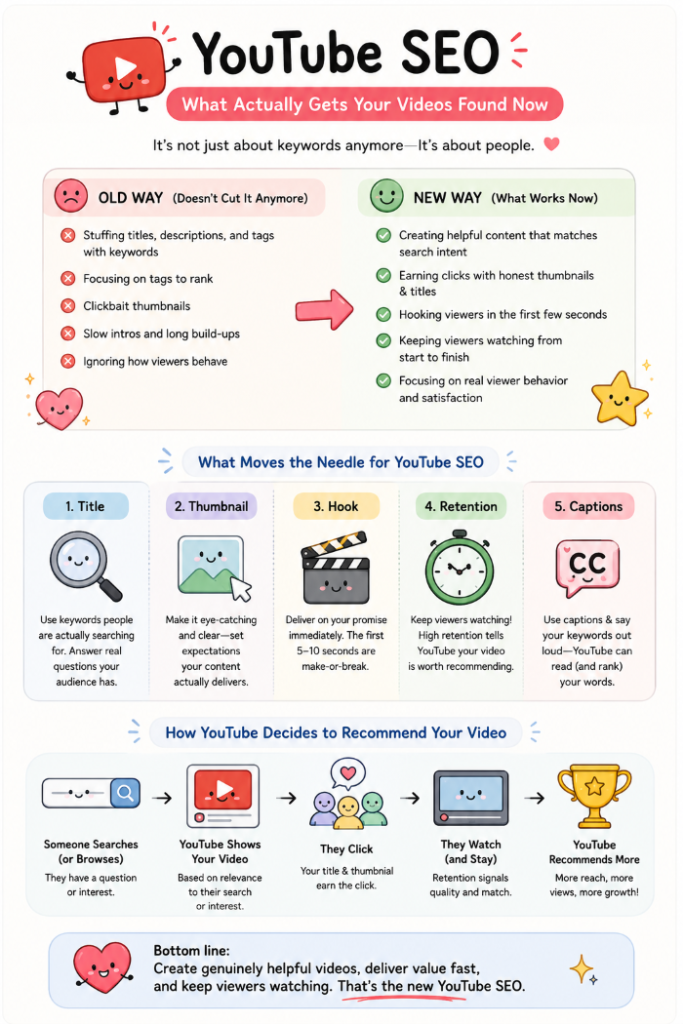
For years, YouTube SEO meant stuffing your title, description, and tags with the right keywords and hoping the algorithm noticed. That approach is fading fast. YouTube now leans much more heavily on how real viewers behave once they click on a video: whether they watch, how long they stay, and whether the video leads them to watch something else. Metadata still plays a role, but it is no longer the main lever pulling your videos into search results and recommendations.
Our team at NetLZ has been watching this shift closely, especially as more of our clients lean into video as part of their content strategy alongside their written SEO work. If you are still treating YouTube SEO like it worked five years ago, this is the update that should change your approach.
What Is YouTube SEO
YouTube SEO is the practice of optimizing your videos so they show up when someone searches on YouTube or Google, and so YouTube’s recommendation system chooses to surface them to the right viewers. This includes your title, description, and captions, but it now weighs viewer behavior just as heavily, sometimes more heavily, than the words you use to describe the video.
Video SEO more broadly covers the same idea across any platform hosting video content, but YouTube remains the largest and most search-driven of them, which is why it deserves its own strategy rather than getting lumped in with general social content planning.
Why Tags and Keyword Stuffing Don’t Work Anymore
YouTube has gotten much better at reading a video’s actual content: the words spoken in it, the on-screen text, the topic it covers, and how people respond once they press play. Click-through rate, watch time, and retention now carry real weight in how a video gets ranked and recommended. Tags still help YouTube understand context, but a well-tagged video with poor retention will lose out to a loosely tagged video that holds attention from start to finish.
This is a meaningful shift for businesses using YouTube marketing as part of their strategy. A video packed with keywords in the title and description but with a weak hook in the first few seconds is not going to perform the way it might have a few years ago. Viewers clicking away in the first ten seconds sends a clear signal to YouTube that the video did not deliver on what the title promised, and that signal now outweighs the keywords sitting in the description box.
What Moves the Needle for YouTube SEO
Getting a video found today depends on a mix of relevance and performance, not just relevance alone.
Your title needs to match what people are really searching for, using the keywords for YouTube videos that reflect real questions your audience is asking, not vague or clever phrasing that means little to the algorithm or the viewer. Your thumbnail needs to earn the click without misleading anyone about what the video contains, since a strong click-through rate that is not backed up by real content will hurt you as viewers click away quickly. Your first few seconds need to deliver on the promise of the title immediately instead of building up to it slowly, because retention in the opening moments carries enormous weight in how YouTube decides whether to keep recommending the video.
Captions and transcripts matter more than most businesses realize. YouTube can read the spoken content of your video directly, which means saying your important keywords out loud, not just writing them into the description, gives the algorithm more to work with. This is one of the simplest and most overlooked pieces of YouTube SEO available right now.
How This Connects to the Rest of Your Search Strategy
Video should not sit in its own silo separate from the rest of your SEO and content work. The keyword research you already do for your website and blog applies directly to your video titles and topics, since the questions your audience types into Google are often the same ones they are typing into YouTube search.
We build video into our clients’ broader video content strategy for exactly this reason, treating it as another surface where the same core keywords and buyer questions show up, rather than a separate creative project disconnected from search intent.
This connects to platforms beyond YouTube too. We wrote recently about TikTok and Instagram SEO, and the same principle holds across all of them: platforms are increasingly built around search behavior, and the businesses that treat video as part of their SEO strategy rather than pure entertainment content are the ones getting found consistently.
It also plays a role in how AI systems understand your brand. Generative engine optimization (GEO) is about making sure tools like ChatGPT and Google’s AI Overviews can accurately understand and cite your content, and video transcripts are increasingly part of that picture. A video with clear, well-structured spoken content gives AI systems clean material to pull from, the same way a well-written page does.
Choosing a YouTube SEO Partner
If you are looking into YouTube SEO services or a YouTube SEO agency to help with this, ask how they think about retention and viewer behavior, not just keyword placement. A partner still focused only on titles, tags, and descriptions is optimizing for an older version of the algorithm. Video SEO services worth paying for should include guidance on hooks, pacing, and structure, not just a keyword-stuffed description template applied to every upload.
The businesses that treat their video content the same way they treat their website content, built around real search intent and structured to hold attention, are the ones seeing consistent growth in views and subscribers rather than the occasional lucky spike.
The Bottom Line on YouTube SEO
YouTube SEO has not gone away. It has gotten more honest. A video with the right keywords but a weak first ten seconds will not perform, and a video with strong retention but sloppy metadata will not get discovered in the first place. Both pieces count now, and treating one without the other leaves real visibility on the table.
For a broader look at how search fundamentals apply across your website, video, and everything in between, our ultimate guide to SEO is a solid place to start. And if you want a second set of eyes on your video strategy specifically, our team at NetLZ would be glad to look at what you are working with.