

If you run a managed service provider, you already know the hardest part of your job has nothing to do with the technology. It is convincing a business to trust you with their network, their data, and often their entire ability to operate day to day. That is a serious decision for a prospective client, and most MSP websites do very little to help them make it. A features list and a page of bullet points about uptime and support tiers does not answer the questions running through a buyer’s head before they pick up the phone.
We work with a lot of B2B and IT companies, and MSPs consistently stand out as a business type whose marketing lags far behind what their services are really worth. That gap is the opportunity. A prospective client is quietly researching for weeks or months before they ever reach out, and most MSPs are not giving them anything to find during that window.
What MSP Marketing Needs to Do
MSP marketing is not about listing your services more clearly. It is about building a website around the buyer’s decision process instead of your own list of offerings. A prospective client is not just comparing prices or support tiers. They are trying to answer a much bigger question: can we trust this company with something this important.
That means your site needs to do more than explain what managed services are. It needs to address the specific hesitations a business owner has before signing a contract, the industry-specific compliance concerns, the response-time worries, the fear of getting locked into a bad vendor relationship. A generic services page answers none of that, which is exactly why so many MSPs lose prospects who never even pick up the phone to ask.
Why Marketing for MSPs Is Still So Underdeveloped
Marketing for MSPs tends to lag behind other B2B categories for a simple reason: most MSPs were built by technical people solving technical problems, not by marketers thinking about what a nervous, research-heavy buyer needs to see. The result is a website built around what the company offers rather than what a prospective client is really worried about.
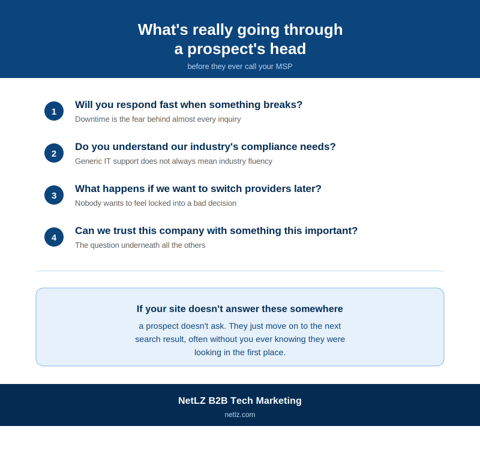
Marketing for it companies works best when it addresses the real hesitations behind a decision this significant. Will they respond fast when something breaks. Do they understand our specific industry’s compliance requirements. What happens if we want to switch providers later. If your site does not answer these questions somewhere, a prospective client is left to guess, and most of them will not bother guessing. They will just move on to the next search result.
The MSPs pulling ahead right now are the ones building content around these exact hesitations instead of assuming a services list will do the convincing for them.
What Your Marketing Needs That General B2B Advice Doesn’t Cover
IT marketing shares a lot of DNA with general B2B marketing, but your audience’s technical literacy varies enormously, and that changes how your content needs to be written. A business owner without an in-house IT background needs plain, jargon-free explanations of what managed services really mean for their day-to-day operations. A business with an internal IT lead evaluating outside support needs a more technical conversation entirely, one that respects their existing knowledge instead of oversimplifying everything.
The strongest MSP content speaks to both audiences without alienating either one, answering the practical business question first and layering in the technical detail underneath for the reader who wants it. We build this kind of layered content into the work we do for our IT marketing clients, since a single generic page trying to serve everyone usually ends up serving no one particularly well.
What to Look for in an MSP Marketing Agency
If you are evaluating an MSP marketing agency or MSP marketing services, the most useful question to ask is how they plan to shorten your sales cycle. A partner who only talks about keywords and traffic numbers is missing the point. Your prospects do not convert on their first visit. They convert after several visits, often across weeks, once they have found enough evidence that you understand their specific situation.
Good MSP digital marketing treats your website as a resource built for that entire research window, not just a landing page waiting for a form submission. That means detailed content addressing specific industries, specific compliance concerns, and specific technical scenarios, not a single page trying to cover every possible client at once.
This is the approach we bring to the B2B tech marketing work we do for MSPs and IT companies, treating your long sales cycle as something to build content around rather than something to fight against.
How AI Search Is Changing How Businesses Find an MSP Like Yours
There is a shift worth planning for too. Business owners increasingly ask ChatGPT or Google’s AI Overviews to compare managed service providers before they ever land on a company’s website directly. If your content only exists as a generic services page, these AI systems have very little to work with when a prospective buyer asks a specific, detailed question about a provider like you.
This connects directly to generative engine optimization (GEO), which is about structuring your content so AI systems can understand it clearly enough to cite it in an answer. An MSP with detailed, well-organized content addressing real buyer questions has a much better shot at being the provider an AI system recommends, rather than being left out of the conversation entirely.
Managed services marketing that accounts for this shift now is building an advantage that will only compound as more of your prospects start their research this way instead of with a traditional search.
The Bottom Line on MSP Marketing
If your website still reads like a features list, you are leaving real business on the table, not because your service is not good enough, but because prospects cannot find the answers they need to trust you before they ever call. The MSPs willing to invest in detailed, buyer-focused content are the ones who will be easiest to find and easiest to trust once a business starts looking.
If you want to see specifically where your current site is falling short of what a research-heavy buyer needs, our team would be glad to take a look and show you what we would prioritize first. For a broader look at how search fundamentals apply to your site, our ultimate guide to SEO is a solid place to start.